
ORBITAL game manual
Everything you need from your first five minutes to the day you take the enemy capital, on one page. Settings (☰) → How to Play in the game is the short version of this manual.
Contents
1. Getting started
- Pick a group (server). Groups are named by number and faction, such as "Empire 1" and "League 1", and front n is always Empire n against League n. Join the group your friends are in or the recommended one. An invite link takes you straight to its group, and to its general if a commander sent it.
- Pick a general to support. Each general takes up to 100 supporters and fields 100 ships. Every general number has its own specialty. You can move to another general of your faction at any time.
- Follow the "First operation" checklist. The front screen lists five things you can finish on your own in your first session (commander: attack → watch → build → deliver → resupply; supporter: send energy → watch → build → deliver → auto-build). "Go" takes you to the right screen.
2. Screens
Move between tabs in the sidebar on the left (the menu button on a phone). The top bar shows your personal alloy, energy and research, and the time to the next turn.
| Tab | What you do there |
|---|---|
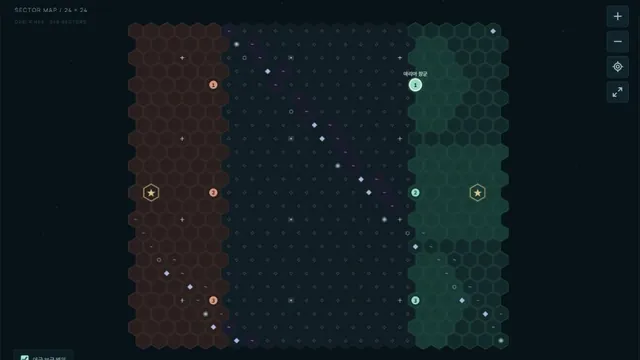
| Space Front | Hex map, generals, supply network, orders (move, attack, defend, resupply), long-range goals, recent battles and replays. |
| My Planet | Upgrade your four facilities and see their output per turn. |
| Shipyard | Build ships by class, design and quantity; deliver finished ships; auto-delivery and auto-build while online. |
| Generals & Squadrons | Change general, fleet formation of 100 ships, battle orders, growth stats, AI policy, command and member management. |
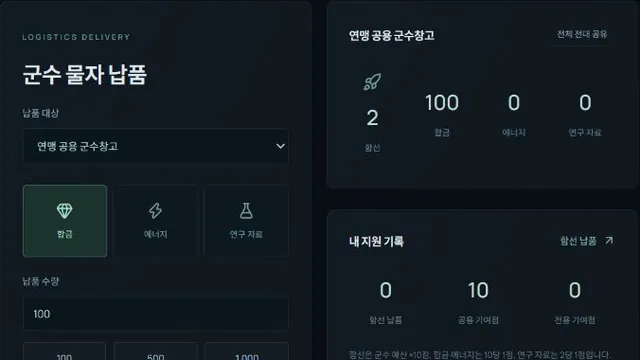
| Logistics Ranking | Deliver alloy, energy and research, the faction's shared depot, era and all-time rankings. |
| Reign Records | Turns left in a reign and its taxes, past unifications and top contributors. |
| Story | The 24 chapters of the main story and its characters. |
Settings (☰) at the top right holds music, language (한국어/English), Pioneer settings, How to Play, Game Manual, Notices, Letters to the Operator and Change group.
3. Planet and resources
There are three resources: alloy, energy and research data. Your facilities produce them every turn, and up to 8 hours of output builds up while you are away.
| Facility | Effect (per level, per turn) |
|---|---|
| Orbital mine | Alloy 180 |
| Stellar power plant | Energy 120 |
| Advanced lab | Research 36, and the tech level of new ships (+2.5% hull, shield and firepower per level, up to +12.5%) |
| Orbital shipyard | More build orders at once and faster building (+20% per level) |
- Facilities go up to level 6 and keep their levels from era to era.
- The first upgrade (1→2) is cheap — alloy 3,000, energy 1,500, research 300 — so you can make it in your first session. From level 2 the cost grows with the square of the level.
- Guests produce half of what a signed-in account does. Sign in to a breyes.net account to double it.
4. Shipyard and ships
Choose one of four classes and a design. Your hangar and ships under construction hold up to 60 ships together.
| Class | Cost (alloy/energy/research) | Build time | Role | Strong vs / weak vs |
|---|---|---|---|---|
| Battleship | 240 / 130 / 0 | 3 min | Air defense escort; shoots down nearby fighters | Carrier / Cruiser |
| Cruiser | 320 / 190 / 15 | 3.6 min | Piercing bombardment | Battleship / Assault ship |
| Assault ship | 480 / 290 / 30 | 4.5 min | Close-range tank; takes 20% less from battleships and cruisers while closing in | Cruiser / Carrier |
| Carrier | 650 / 400 / 50 | 5.1 min | 18 fighters | Assault ship / Battleship |
Counter ring: Battleship → Carrier → Assault ship → Cruiser → Battleship. A ship deals ×1.6 damage to the class it counters and ×0.7 to the class it is weak to. A fleet of one class falls to its weakness, so a mixed fleet is the default.
Designs
| Design | Effect | Budget |
|---|---|---|
| Standard design | Balanced baseline | ±0 |
| Up-gunned | Main guns and melee +30% · resources +5% · time +30% | +2 |
| Layered shields | Shield +45% · hull +15% · resources +8% · time +20% | +2 |
| Mass production | Resources −8% · time −30% · hull −10% · all firepower −12% | −2 |
A general's 100 ships fit inside a logistics budget of 1,400 (battleship 10, cruiser 12, assault ship 15, carrier 17, plus the design). In a 100-ship battle, numbers matter far more than design.
Automation
- Auto-delivery sends finished ships straight to your general (or the shared depot).
- Auto-build while online starts your chosen design in every free slot while you are connected. By default it keeps back the cost of your next facility upgrade (you can turn that off).
5. Deliveries and logistics points
Deliver ships and supplies to a general (that general's store) or to the faction (shared by every general). Fleets use a general's own ships first, then take turns drawing from the shared ships.
| Delivery | Points |
|---|---|
| 1 ship | Design budget × 10 (standard battleship = 100) |
| 10 alloy / 10 energy | 2 each |
| 1 research | 1 |
- The logistics ranking shows the top 50 for this era and all time, overall or by faction. When a side unifies, its top 10 contributors go into the history.
- Deliveries to a general also count as support for that general, which is the influence that decides command.
- Depot supplies keep the fleet going: 25 energy → supply +2, 50 alloy → readiness +15%, 30 research → readiness +5%, used only when needed.
6. Turns and orders
- The war runs by itself in real-time turns. Turn length depends on the front; the default is 3 minutes.
- Each general (fleet) carries out one order per turn: move, attack, defend or resupply. Moves and attacks reach one adjacent hex.
- The fleet's commander schedules the order and can change or cancel it until the turn closes. Without an order the AI follows the fleet's policy (auto-advance or hold position).
- Long-range goal: pick a distant hex on the map and the fleet takes one step along the way on every turn without an order. It stops and hands over to the AI when it arrives, loses a battle, is badly worn down, or runs out of supply.
- Contests over a hex follow a faction priority that alternates each turn, then general numbers. When two fleets attack each other's hex in the same turn, the stronger one (ships × readiness) strikes first.
- A front nobody visits for 30 minutes goes to sleep and wakes when someone enters.
7. Map, supply and fog
Terrain
| Hex | What it does |
|---|---|
| Capital | Origin of the supply network. Defense +15%. Taking the enemy capital unifies the universe |
| Supply base · Shipyard base | Supplies 3 hexes around it while connected to the capital through friendly space |
| Fortress | Defending fleet +10% |
| Resource planet | Adds to reign taxes |
| Observatory · Nebula · Lane | Ordinary hexes to move through and claim |
Independent defenders
Unclaimed hexes are held by independent defenders loyal to neither side (23 ships on a lane up to 44 at an independent capital). Win to claim the hex; lose and you stay where you were. Damage to survivors carries over to the next attack, and claimed hexes never respawn defenders.
Supply and readiness
- Hexes within 3 of the capital and of supply or shipyard bases linked to it through friendly hexes are in supply; they are lit on the map.
- A fleet in supply refills to supply 6 and recovers 8% readiness per turn.
- Outside supply, a fleet loses 1 supply per turn. At supply 0 it cannot launch attacks that need a fight and defends weaker (it can still walk back through empty enemy lanes and nebulae).
- A resupply order tries for extra recovery from depot supplies.
Fog of war
A side sees its own space plus 1 hex around it, and 2 hexes around each of its fleets. Enemy fleets outside that show only where they were last seen (a dotted ring and "N turns ago"). Adjacent hexes are always in sight, so you always see the enemy's numbers before you attack.
8. Battle
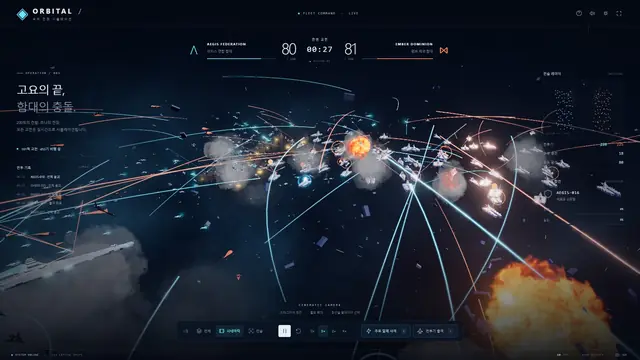
- Engagements are 100-vs-100 fleet battles resolved by the server, which you can watch again as 3D replays. When your fleet fights you get a notice with the result and a "Watch" button.
- A side whose surviving ships fall to 30% or less of what it fielded, and below the enemy's, retreats and the battle ends. The loser brings 30% home.
- Fleets led by a general get a command bonus (hull, shield and firepower ×1.28). Independent defenders do not.
- Of a fleet's 100 places, the AI supplies at most 50 (at 80% readiness); only ships pioneers deliver fill the rest. Fleets with more delivered ships are stronger.
- Sieges: up to 3 allied fleets that attack the same hex in the same turn merge into one battle, at far lower losses than attacking alone.
- Capitals: the garrison musters 80% of the largest attacking fleet (45 to 80 ships), and a capital holds for one turn after losing its first battle. The next attack (or an ally's second win that turn) takes it. A capital alert appears on the map when an enemy comes within 3 hexes.
Formation and battle orders (commander)
- Squadron formation: set the mix of classes and place them on a 10 × 10 grid. Without one, the AI default is used. Only that general's supporters can see it.
- Battle orders: when to fire the main-gun volley, what assault ships do (charge at once, hold then charge, wait to intercept), how carriers launch (waves, focused sorties, hold a reserve then waves) and per-slot ship orders. They apply from the next battle.
9. Generals and command
Specialties
A general's specialty comes from their number, and the Empire's and the League's generals of the same number share it (9–16 repeat 1–8).
| No. | Specialty | Effect |
|---|---|---|
| 1 | Combined command | All classes +3% hull, shield and firepower |
| 2 | Carrier specialist | Carrier fighters 18→21 · carrier shield +10% |
| 3 | Assault specialist | Assault approach armor 20→30% · melee +10% |
| 4 | Bombardment specialist | Cruiser firepower +12% |
| 5 | Air-defense specialist | Battleship intercept interval 1.1→0.9 s · battleship hull +10% |
| 6 | Logistics specialist | Out-of-supply drain 1 per 2 turns · readiness recovery 8→12% |
| 7 | Defense specialist | All classes +8% when defending |
| 8 | Frontier specialist | All classes +10% against independent defenders · half the readiness cost of winning those fights |
General growth
Fleets gain experience from battle and training (one turn in supply, +40 experience) and level up to 20. Each level gives one point the commander puts into Firepower, Protection, Leadership or Logistics (up to 10 each). Supporters can spend supplies on training support (1 experience per 10 logistics points, up to 60 per fleet per turn). Growth carries over between eras.
Command
- Command goes to the online supporter with the most influence: this era's support for the general plus 0.1 × all-time support.
- A challenger who holds 110% of the commander's influence at two turn closes in a row takes over. A commander away for more than two turns hands over at once.
- The commander may appoint up to five staff officers, who can expel members, send general invite links and write command notes; orders, formation and stats stay with the commander.
- The commander and staff can expel inactive supporters from the member list (barred from rejoining for 24 hours; contenders for command cannot be expelled). A commander can step down for the rest of the era.
10. Unification and new eras
- You don't need to take the whole map: capturing the enemy capital unifies the universe.
- The unifying side reigns for 5 turns (15 minutes at 3-minute turns). During a reign only moves and attacks are locked; both sides can still produce, deliver, set formations and order defense or resupply.
- Characters in the unifying group get +25% planet output for the next era.
- When the reign ends, the same two groups start the next era on a new map. Facilities, personal resources, hangar and queued ships, surviving delivered ships, all-time points and general growth carry over; only this era's scores reset.
- If no one unifies within 144 turns, the side with more territory wins.
11. Account, diamonds and chat
- Account: you start as a guest. Signing in to a breyes.net account moves your character to it so you can continue on other devices, and doubles planet output. An account can keep one character per group.
- Diamonds finish a build at once (1 diamond per minute left) or fill resources an upgrade is short of. The shop sells diamond packs, a 30-day Fleet Seal (diamonds every day) and supply transports (8 hours of output). Nothing in the shop raises combat stats directly.
- Chat: group chat (your group only; the other side cannot see it), general chat (fellow supporters) and private messages. Tap a name to message or block that pioneer.
- Notices and Letters to the Operator are in the settings menu.
- Story: 24 chapters unlock over seven days from your first deployment. Reading has no effect on battles.
12. Tips for new pioneers
- Raise all four facilities to level 2 in your first session; the first upgrade takes only a few turns to afford.
- Don't hoard resources: turn them into ships and deliver them to your own general. Only pioneers' ships fill the places beyond the AI's 50.
- Even if you don't command, 25 energy in your general's depot is supply +2 that keeps the fleet fighting.
- One fleet rarely takes an enemy capital. Agree in general chat to attack together in the same turn; the attack confirmation shows allies who targeted the same hex.
- When supply drops to 2 or less, fall back into the lit supply range and refill.
- When in doubt, watch replays. A lost battle's formation shows what your fleet was missing on the counter ring.